Projects
FACCTs is involved in various publicly funded research projects.

KI-LECTROLYTE
Intelligent electrolyte engineering and design for industry using AI-accelerated simulation techniques
Next.In.NRW-Project / Project start / August 01, 2025
The electrolyte is the key link within a battery: it enables ion transport between the electrodes and thus determines the battery’s performance, stability, safety, and lifespan. Even small changes in the electrolyte’s composition or its physical and chemical properties can have a major impact on how a battery functions. New electrolytes can enhance the performance and lifetime of modern batteries, improve their safety, or even open the door to entirely new battery chemistries. This makes batteries more efficient, durable, and cost-effective. However, developing new electrolytes is a complex challenge. A battery contains numerous interacting chemical components, and side reactions that reduce cell performance are almost unavoidable. The vast number of possible components and reaction pathways creates an almost infinite chemical space in which traditional trial-and-error methods quickly reach their limits. Data-driven, model-based development is therefore crucial to identify promising formulations more rapidly and optimize them in a targeted manner. An integrated approach is needed to accelerate development – one that systematically connects experimental data and simulation results to make them useful for electrolyte innovation.
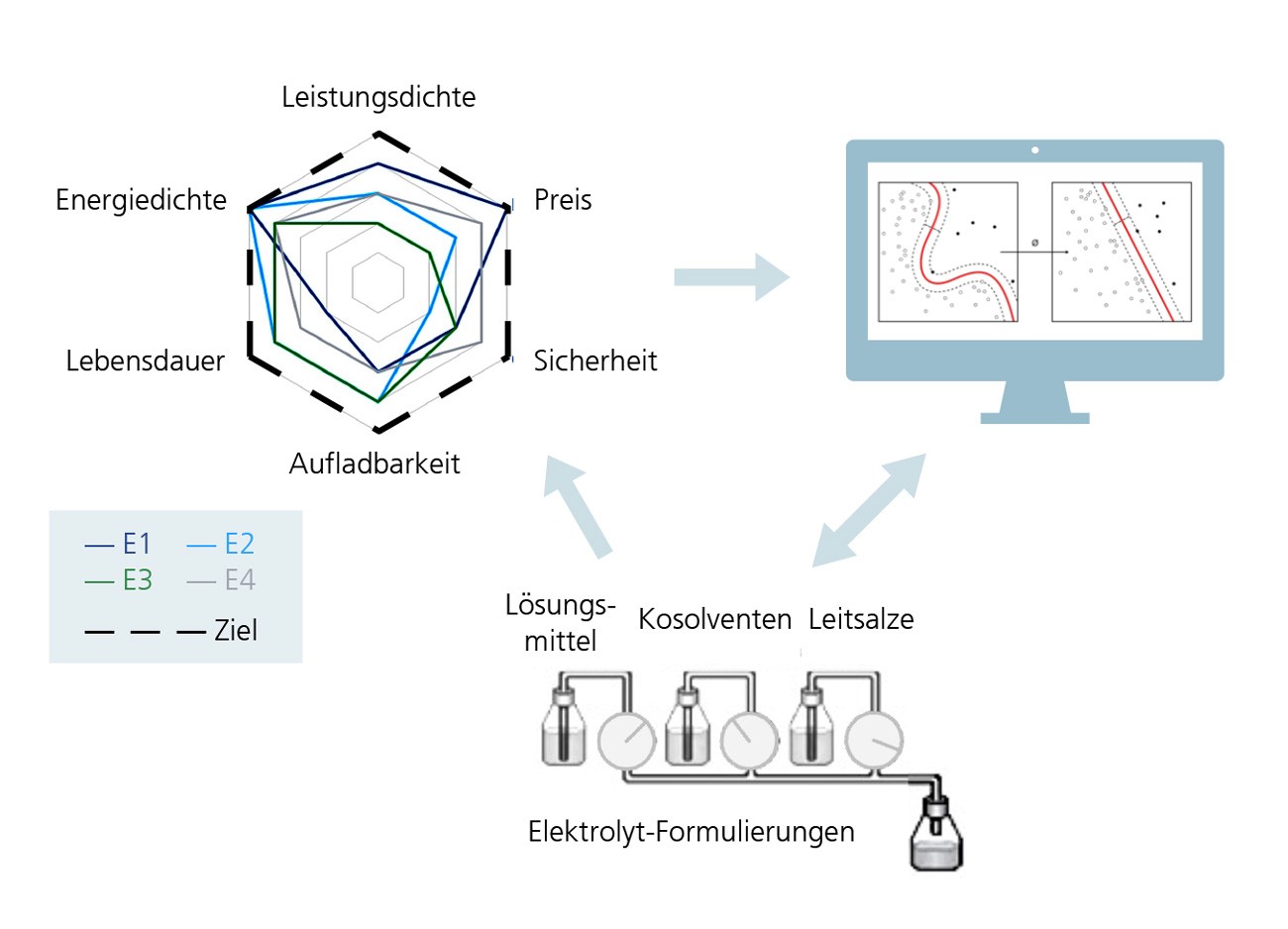
Data-driven tools make it possible to optimize existing electrolyte formulations to enhance the battery performance.
The KI-LECTROLYTE project follows a data- and model-driven approach to discover new electrolyte formulations. The project partners are developing simulation and prediction models to identify electrolyte properties more efficiently. At the heart of the project lies a central electrolyte database that combines experimental data, simulated results, and AI-generated predictions of key material properties. This consolidated database provides high-quality, curated data that support the targeted planning and evaluation of experiments and simulations. The database can be searched specifically for various battery chemistries, such as lithium-ion, sodium-ion, or lithium-sulfur batteries. Using this resource, AI-assisted models can accurately predict electrolyte behavior and propose new formulations to optimize existing systems and explore entirely new chemical concepts. By doing so, KI-LECTROLYTE closes an important gap in electrolyte materials research, since structured and comprehensive databases dedicated to electrolytes are still largely missing.
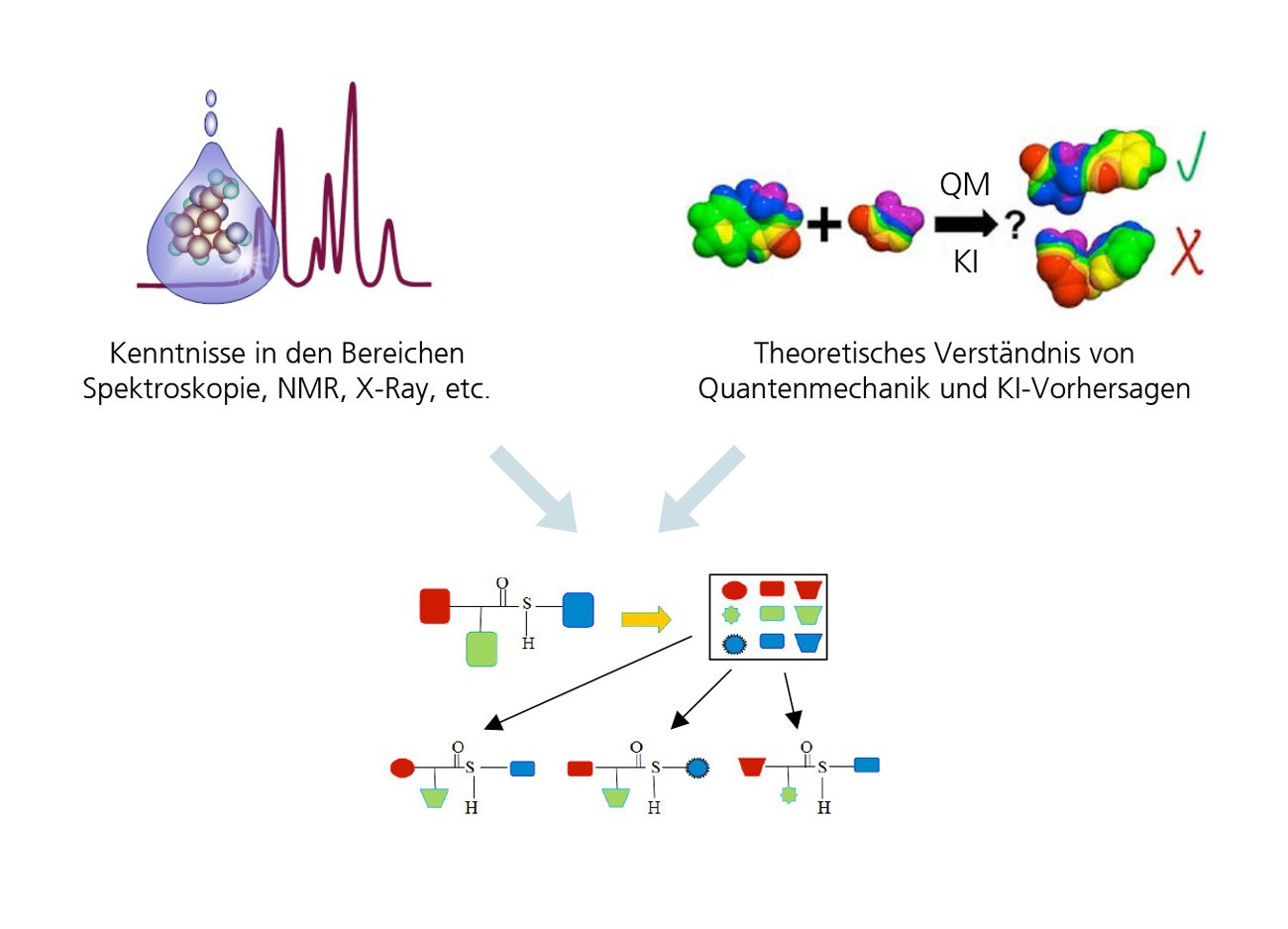
The combination of quantum mechanical simulations and generative AI is giving rise to new electrolyte formulations in the project, and thus potentially new battery chemistries.
Fraunhofer SCAI contributes its extensive expertise in AI-driven materials science, data integration, and knowledge-based modeling. SCAI develops AI models that reliably predict electrolyte properties, drawing on its experience in atomistic simulation. It also designs the data structure of the new electrolyte database, building on years of expertise in battery ontologies. In addition, SCAI develops general AI models for key battery performance indicators (KPIs) and employs cutting-edge transformer architectures and the generative AI tool LLamol to design novel electrolyte molecules.
KI-LECTROLYTE is funded through the Next.In.NRW program by the Innovationsförderagentur NRW (grant agreement no. EFRE-20801094) of the state North Rhine-Westphalia.
Project duration: 08/2025 until 07/2028
QUICHE
Quantum Integrated Chemistry
Quantum chemistry has long been recognised as one of the most compelling early applications for quantum computing. The ability to accurately predict the chemical properties of complex molecules could transform industries ranging from pharmaceuticals to clean energy, yet existing classical methods need supercomputing-level resources to tackle large chemical systems of practical relevance. Overcoming these limits requires a new computational paradigm–one that the Quantum Integrated Chemistry (QUICHE) project, a newly funded UK–Germany partnership, is now working to unlock.
Backed by Innovate UK and Germany’s ZIM programme, QUICHE brings together three organisations with complementary expertise: the silicon-spin CMOS hardware and algorithm developers at Quantum Motion, the developers of the ORCA quantum chemistry software package at FACCTs, and quantum error correction specialists at Riverlane. Their shared mission is to build one of the first practical, end-to-end workflows that allows chemists to run quantum-ready calculations directly inside ORCA, a platform used globally across academia and industry.
At the heart of the project is the technical challenge of translating a chemical system into an algorithm that can run on a quantum computer. QUICHE will focus on electronic structure calculations for novel materials that can be used in solar cells and batteries, aiming to automate the process of efficiently mapping to a quantum circuit. State-of-the-art decomposition and compilation techniques will be used to break the high-level chemistry problem into sequences of hardware-compatible gates, stripping away unnecessary operations and minimising circuit depth. This optimisation step is essential. Without it, even small-scale examples would remain impractical for quantum hardware.
Another major aspect of this project will be the development of two backends–one targeted at pushing the boundaries of classical simulation using the QuEST ecosystem, supported by Quantum Motion. The second backend will enable resource calculations for large systems beyond the capabilities of classical compute, providing estimates of qubit counts and the runtimes required for practically relevant problems. Together, the decomposition pathway and quantum backends will be integrated with ORCA, allowing chemists to explore quantum computing without deep expertise and paving the way for an automated pipeline to execute impactful applications directly on quantum hardware.
Aleksei Ivanov, staff quantum scientist at Riverlane, underscores the ambition behind the project:
“Chemical simulation is one of the most promising application domains for quantum computing. Through QUICHE, we’re developing circuit optimisation techniques that will help early fault tolerant quantum hardware run chemistry calculations more efficiently and at higher accuracy.”
One of the most important aspects of this project is to ensure that all the technical work remains accessible to the chemists who will ultimately use it.
Markus Bursch, computational chemist at FACCTS, notes:
“Our goal is to give chemists seamless access to quantum computing through the tools they already know and trust in successful research environments. QUICHE will enable us to explore the connection between quantum mechanics and quantum computation at a practical level without overwhelming users with unnecessary complexity.”
ORCA’s frontend is being extended so users can run quantum-computing enabled pathways without having to learn new tools or programming languages. The consortium is building the mechanisms that automatically pass chemical information into the quantum pipeline and validate results against ORCA’s high-accuracy classical methods. By grounding the project in the workflows chemists already rely on, FACCTs makes quantum computing a natural extension of the tools used by tens of thousands of scientists worldwide.
The combination of these contributions will create something genuinely unique: a pathway that spans chemistry, algorithms, quantum circuits, and hardware realities – something that neither academic prototypes nor isolated cloud-based demos have previously achieved.
Expanded upon by Thomas Bromley, applications lead at Quantum Motion:
“QUICHE will enable us to bridge the gap between quantum hardware and real chemical problems the industry needs to solve. Integrating with ORCA, one of the most popular computational chemistry program packages, our approach will allow scientists to explore impactful applications without needing to carefully design the underlying quantum algorithm, a crucial step in the path towards practical quantum computing.”
Through this combined research initiative, the three organizations have formed a truly coordinated and highly practical approach to quantum-integrated chemistry. QUICHE will allow researchers to develop, test and refine quantum workflows today, building familiarity, accelerating research, and informing the future quantum hardware innovations. Moreover, by outputting detailed resource calculations, the QUICHE project will give industries a way to understand their specific chemistry problems and the right time for investments in future quantum hardware.
This project is not just preparing for the future of quantum computing; it is actively shaping it.
For more information, visit: https://gtr.ukri.org/projects?ref=10150101
About the authors:
Thomas R. Bromley is the Applications Lead at Quantum Motion, working to identify quantum computing use cases and develop the underlying quantum algorithms. Tom has over a decade of experience in quantum computing and leads a team of researchers and software developers to build applications that complement Quantum Motion’s silicon spin quantum dot hardware.
Aleksei Ivanov is a Staff Quantum Scientist at Riverlane. His work involves optimization of quantum algorithms for materials science and quantum chemistry applications, contributing to the advancement of quantum error correction (QEC) technology. Ivanov has a strong background in computational sciences, chemistry, physics, and quantum computing, and he is actively involved in various projects and events related to quantum technology.
Markus Bursch is a computational chemist associated with FACCTs GmbH. He has a strong background in quantum chemistry and computational chemistry, contributing to various scientific publications and collaborations. Bursch is involved in developing software solutions to facilitate quantum chemistry for theoretical, computational, and experimental chemists.
Get in touch
If you are interested in our products or services, please send us a message and we will get back to you.
CONTACT US